Posts

How do ball valves work?

Image
Understanding how a ball valve works is very simple. It is usually designed with a large drilled hole that runs from one side to the other through the center. The ball fits snugly into the base inside the pipe opening (port). It is attached directly to the valve's operating handle, which is usually located above or to the side of the device, usually on the outside of the piping assembly. By turning the handle, usually a quarter turn to 90 degrees, the ball rotates about its axis within the port.   This action aligns the hole in the sphere with the direction of flow of the media in the pipe, allowing it to  pass freely through the ball valve . This is referred to as the open or open position. Turning the handle back 90 degrees in the other direction, closed or off, rotates the ball so that the hole through it is perpendicular to the direction of flow. At this point, the medium can no longer pass through the ball valve and the flow is completely blocked.   Application of ba...

For ball valves, we will be your better choice, have a try?

Image
Ball Valves A ball valve is a valve that uses a hollow, rotating ball to cut off, distribute, and redirect the flow of media in a pipeline. It can also be used for fluid regulation and control. Ball valves provide very good shutoff capability. A simple quarter turn (90°) is all it takes to open or close the valve. If the hole in the ball is in line with the flow rate, the valve opens, and when the ball is rotated ninety degrees using the valve handle, the valve closes. This feature minimizes valve operating time and reduces the potential for leakage due to gland seal wear.   The primary function of a ball valve is to isolate parts of a piping system by starting, stopping or regulating the flow of media (usually water, air or gas) between different chambers, pipes and ducts. This is accomplished by allowing the media to pass freely through the ball valve, by allowing the media through a narrow opening section, or by stopping the flow altogether. Depending on the valve type and handl...

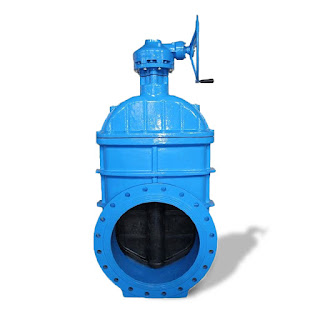
Resilient DI Seat Soft Sealing Gate Valve

Image
Resilient DI Seat Soft Sealing Gate Valve Soft sealing (resilient seat) gate valve  The valves disc is rubber-packed to get excellent sealing effect by the rubber's resilient deformation. Non-rising resilient seated gate valves  solve the problem in general gate valves such as leakage, rusting etc.  Low torque operation,Rubber encapsulated wedge,Fusion bonded epoxy coated inside and outside. Application:  Pipelines to convery oil and storage facilities, Water and wastewater technology, The wellhead device of the oil and gas expoitation, Water engineering. Each product will be carried out appearance, material, air tightness, pressure and shell testing before leaving the factory ;unqualified products are resolutely not allowed to leave the factory. Soft sealing gate valve Gate Valve Size: DN150-DN600 Gate Valve Pressure:  PN10 Gate Valve /PN16 Gate Valve Gate Valve Standard:  EN593, DIN 2501 PN6/10/16, DIN3202 F4

Swing check valve

Image
  Swing Check Valve Swing check valve Swing-flex Check Valves  are certainly a few of one of the most typical check valves used in water and wastewater pumping systems. They are easily available and relatively inexpensive. They are likewise automatic, call for no external source of power, and also are led just by the instructions of water circulation. Right here are a few of the different types of swing-flex check valve. Dual disc type This type of check valve features a counter-clamp body design and two D-shaped discs that revolve apart as flow gets in the shutoff. It has excellent anti-slip characteristics, yet is not recommended for wastewater treatment. It is additionally at risk to vibration and wear. Conventional Swing Check Shutoff This is absolutely one of the most typical type of check valve used in water and wastewater applications. This sort of valve normally has a steel or resistant seat with a 60-90 level swing. Nonetheless, this kind of shutoff tends to bang as a...

Rising Stem Globe Valve Vs Swing Check Valve

Image
One of the most crucial valves in water and wastewater pumping systems is the check valve. These shutoffs help minimize power usage and also secure the pumping system from pressure rises as well as turn around flow damage. Let's compare   Rising Stem Globe Valve  and swing check valve. Rising Stem Globe Valve Rising stem globe valves. Rising stem globe valve valves are typically used in skyscrapers, industrial as well as nuclear power plant applications, as well as water as well as wastewater applications. They have no exterior moving components and are known for their economic situation as well as dependability. Gradually, these types of valves can have high power expenses since the disc stays in the water flow during procedure. Below are a few of the different types of rising stem globe valve valves. Quiet Check Shutoffs Quiet check valves are understood for their peaceful shutoff. The circulation presses the disc and creates it to stream forward. When the pump stops, the co...

In order to calculate the size of a valve

Image
●The operating pressure, i.e., the pressure at which the medium circulates through the valve. ●Flow rate and velocity of the fluid. The flow rate and rated velocity are essential elements to help you select the right valve, especially for regulating that flow. The flow coefficient (Kv) is a theoretical value specified by the manufacturer that allows you to calculate the nominal flow rate of the valve. It can be expressed in liters per minute (l/min) or cubic meters per hour (m3/h). The valve manufacturer provides charts to determine this coefficient based on the required flow rate and nominal diameter. ● The nominal diameter (DN) of the circuit  in which the valve is located. This is essential to avoid oversizing the valve, which may lead to unstable operation of the equipment, or to avoid undersizing, which may lead to a significant pressure drop and rapid valve damage.

How to calculate the size of a valve?

Image
In order to calculate the size of a valve, you need to know the parameters related to the operation of the circuit. ●The pressure is an important factor that must be taken into account, on the one hand to avoid undersizing the valve, which could lead to problems in terms of leakage or rupture of the valve, and on the other hand to avoid oversizing the valve. ●The operating temperature needs to be determined, i.e. the temperature of the circulating medium, as well as the ambient temperature around the valve body. It is important to know the temperature extremes that the valve needs to withstand in order to be able to select the valve that can be used to operate under these conditions,  especially the materials used to manufacture the body, shut-off system and seals . ●The operating pressure, i.e., the pressure at which the medium circulates through the valve.