Posts

How Does Cast Iron Gate Valve Work?

Image
As an   Industrial Valve Manufacturer , share with you. The gate valve is a gate for opening and closing. The movement direction of the gate is perpendicular to the direction of the fluid. The gate valve can only be fully opened and fully closed, and cannot be adjusted or throttled. The gate valve is sealed by the contact between the valve seat and the gate plate. Usually the sealing surface will be welded with metal materials to increase wear resistance, such as 1Cr13, STL6, stainless steel, etc. The gate has a rigid gate and an elastic gate. According to the difference of the gate, the gate valve is divided into a rigid gate valve and an elastic gate valve. Cast Iron Gate Valve The opening and closing part of the gate valve is a gate. The movement direction of the gate is perpendicular to the direction of the fluid. The gate valve can only be fully opened and fully closed, and cannot be adjusted or throttled. The gate has two sealing surfaces. The two sealing surfaces of the most...

What are the General Requirements for Resilient Seated Gate Valves?

Image
As a   China Valve Manufacturer , share with you. The opening and closing part of the elastic seat-sealed gate valve is a gate. The movement direction of the gate is perpendicular to the direction of the fluid. The gate valve can only be fully opened and fully closed, and cannot be adjusted or throttled. Resilient Seated Valve The gate has two sealing surfaces. The two sealing surfaces of the most commonly used model gate valve form a wedge. The wedge angle varies with valve parameters, usually 50, and 2°52``'' when the medium temperature is not high. The gate of the wedge gate valve can be made into a whole, called a rigid gate; it can also be made into a gate that can produce slight deformation to improve its manufacturability and compensate for the deviation of the sealing surface angle during the processing. The plate is called an elastic gate. Resilient seat seal gate valve is also called lifting rod gate valve. Usually there is a trapezoidal thread on the lifting rod, thr...

Advantages and Application Fields of Wafer Butterfly Valve

Image
KXC new design wafer butterfly valve has absorbed the advantages of foreign butterfly valve products. With unique structural design and superb processing technology, the product performance is safe and reliable. It greatly improves the service lifetime of the product. Wafer butterfly valve opens and closes quickly, Also saves effort, has low fluid resistance, it can be operated frequently. Most important is that butterfly valve can achieve good sealing under low pressure. Wafer butterfly valve is widely used in water supply and drainage, sewage treatment, central air conditioning, heating, chemical, marine, paper, food and other fields. It is the first choice for the most users.

Features and Advantages of KXC Soft Seal Gate Valve

KXC soft sealing gate valve adopts a wedge-shaped rolling plate structure, and the gate adopts high-quality rubber for inner and outer rubber, and the deformation compensation effect of the gate rubber is used to achieve a good sealing effect.The valve adopts a non-toxic epoxy resin coating as a functional anti-corrosion. The valve is opened and closed by using the rotating valve stem to drive the upper and lower strokes of the gate through the copper nut. The soft seal gate valve has the characteristics of zero leakage, not easy to accumulate slag, corrosion resistance, good interoperability, small fluid resistance and unlimited medium flow, small torque required for opening and closing, and long service life. It is widely used in water supply, construction, petroleum, chemical, food, medicine, textile, electric power, heating ships, and metallurgical industries. KXC soft-seal gate valve strictly installs national industry standards in the procurement, manufacturing and processing of...

The Development History of Butterfly Valve

Image
In the 1930s, the United States invented the butterfly valve . It was introduced to Japan in the 1950s, and it was only widely used in Japan in the 1960s. However, it was promoted in China after the 1970s. In the world, gate valves generally above DN300 mm have been replaced by butterfly valves. Compared with the gate valve, the butterfly valve has the advantages of short opening and closing time, small operation moment, small installation space and light weight.Compared with gate valves, butterfly valves have short opening and closing time, small operating torque, small installation space and light weight. The disadvantage of the rubber soft-seal butterfly valve is that when used for throttling, cavitation will occur due to improper use, causing the rubber seat to peel off and damage. Therefore, metal hard-sealed butterfly valves have been developed internationally, and the cavitation area has been reduced. In recent years, China has also developed metal hard-sealed butterfly valves. ...

The Working Principle of Butterfly Valve

The butterfly valve is a valve that uses a circular butterfly plate as a switch part and rotates with the valve stem to open, close and adjust the fluid passage. The butterfly plate of the butterfly valve is installed in the direction of the pipe diameter. The butterfly plate rotates around the high pressure, and the rotation angle is between 0° and 90°. When the rotation reaches 90°, the valve is in a fully open state. Generally, the life of the seal seat is 15-20 years for rubber and 80-90 years for metal under normal conditions. However, the correct selection depends on the requirements of the working conditions. The relationship between the opening of the butterfly valve and the flow rate basically changes linearly. If it is used to control flow, its flow characteristics are also closely related to the flow resistance of the piping. For example, two pipelines are installed with the same valve diameter and form, but the pipeline loss coefficient is different, the flow rate of the v...

Hydraulic Control Valve

Image
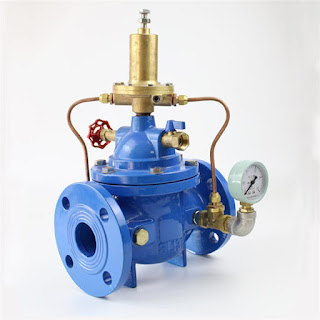
Hydraulic Control Valve KXC   Hydraulic control valves  are used to contain and transfer the flow and pressure of hydraulic fluid in hydraulic systems. There are many different designs hydraulic control valves , including check, cartridge, directional, relief, safety, shut off and solenoid valves. Hydraulic control valves come in a variety of sizes and pressure ratings. In an open position, hydraulic valves  permit the flow of fluid; when in a closed position, they prevent flow. Hydraulic control valves are used to prevent improper levels of pressure and fluid in hydraulic systems. The basic mechanics of all hydraulic control valves essentially remains the same; each is usually cylindrical and occasionally contained in a small square-shaped house, placed at the mouth of a pipe or on the head of a pump and contains a seat in the opening that cradles the plunger that may be a variety of shapes and sizes. These various styles are mass produced in general cavity sizes, as wel...